
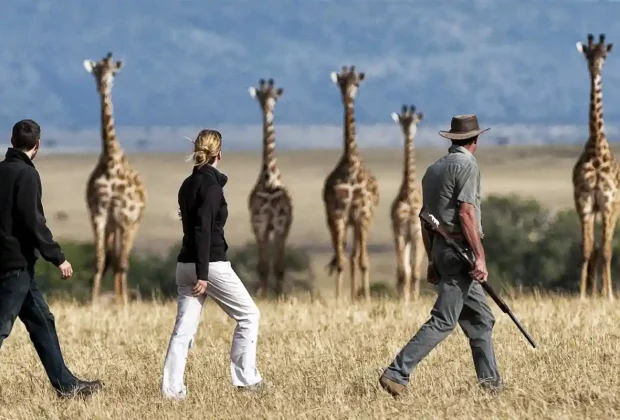
Walking safaris are the purest form of safari. Walking in Tanzania is completely different from game driving. On foot, you are a participant in the world of wildlife, rather than a spectator, for a thrilling and unbeatable safari experience.
Our African walking safaris offer a unique opportunity to observe and learn about the behaviours of animals in their natural habitat. While large game may be seen from a distance, the emphasis is on observing and understanding the ecosystem as a whole, often focusing on the smallest contributors, usually overlooked from the height of a vehicle. Accompanied by your knowledgeable guide, you’ll have the chance to get close to smaller animals and birds and even discover fascinating insects along the way.
Walking is only available in certain areas and can be short day walks back to the same camp, or can be mobile, where the crew pack up your camp and move it for you, greeting you at the end of your day’s walking journey with sundowners.
Trekking is the next level of wild, where you backpack through the wilderness and camp in a new location each night. Tents are lightweight, the team is very few, so the focus is on immersion, getting stuck-in, and wilderness rather than luxury.
Why Walking Safari
Feel, hear, and smell Tanzania
Imagine, you walk on the same path as the elephants and other wildlife, you feel the wind through you hair, hear a lion roar in the distance and smell the bush and wildlife. Your senses awaken, as you become part of your environment and the wilderness becomes more real.
Wildlife up close and personal
While animals will generally ignore you in a vehicle, they see you as another type of animal when you are on foot. Getting up close and personal with wildlife is definitely a rush of excitement. Walking is also a great way to appreciate the smaller wildlife, which can’t be so easily seen from a vehicle.
Access remote areas on foot
On foot you can walk into remote areas and reach places that a safari car can’t. Once on foot, you are not constrained by roads and can go almost anywhere you like. Away from the crowds, off the beaten track. It offers you a freedom incomparable to any game drive safari.
What is a Walking Safari?
Walking safaris can be described as a guided hike through the bush. Led by a guide, a tracker, and possibly a local/Maasai guide, trails range from routes blazed by game or cattle herders to total wayfinding. Differentiated from bush walks—which tend to amble near camp and last about an hour—walking safaris are an extended jaunt through the wilderness. In their purest form, walking safaris return to camp each night—whether it’s a fly, mobile, or permanent installation.
Why Go on a Walking Safari?
On foot, your senses sharpen. Immediately, your primordial instincts respond to the sights, sounds, and smell of the wilderness. Slowing down means the savannah’s supporting actors take center stage. Without a rumbling engine, you’ll notice laboring insects and delicate blooms while suddenly paying great mind to the direction of the wind.
Who Will Enjoy a Walking Safari?
Walking safaris appeal to both seasoned safari-goers and first timers. What underwrites the experience for all is the opportunity to stretch your legs while taking a walk on the wild side. Traditional safari days revolve around twice-daily game viewing drives—which means you’ll log quite a few miles seated in a 4×4. The opportunity to (quite literally) get off the beaten path opens you up to unscripted moments in unspoiled nature. You’ll also appreciate the depth of knowledge your guide will impart, from plant and track identification to reading the signals of the bush.
For those who are wild at heart, embark on expedition-style walking safaris that last seven to ten days, threading together a diversity of landscapes. On these epics, you’ll hike nine to 15 miles each day, arriving at a fully assembled fly camp where comforts like warm bucket showers and hot meals greet you.
Are African Walking Safaris Safe?
It’s completely natural to raise an eyebrow at the idea of walking through big game territory outside of the safety of a vehicle. A walking safari is not without risk but with highly trained, expert guides, you’re in good hands. What’s more, someone in the party will be armed at all times. Pre-departure, guides will deliver a safety briefing. Following rules (like walking single file) and closely following guides’ instructions is paramount. Also, be mindful of the elements. Keep hydrated, protect yourself from the sun, and dress appropriately. Children are not permitted on walking safaris.
Guest safety is a value we share with our preferred partners, which is why we only work with the most reputable operators.
Wait, What is Fly Camping?
Despite what the name suggests, fly camping has nothing to do with flight. Rather, it’s a nod to the old school safari days when hunters took shelter beneath simple “flysheets”— lightweight covers that drape across a tent. Fly camp is a special experience offered at some safari camps, drawing guests out from luxurious canvas tents and into the bush for an unfettered night (or two) in the wilderness. You’ll walk to the fly camp in the company of a guide and a ranger to reach a fully assembled camp complete with your own minimalist, netted tent, a dining configuration, a long drop toilet and perhaps a warmed bucket shower. Sip a sundowner before tucking into a hot meal and then gather around the campfire beneath a starry sky. A ranger or warrior will keep watch for any wild things that go bump in the night.
Are Walking Safaris Strenuous?
Walking safaris are not highly technical and you won’t have to carry more than a day pack with drinking water. The terrain may be uneven and distances traveled may be moderate, but your guides will use any curiosity as an excuse to stop. You’re also likely to set out early in the morning, arriving at camp by noon to avoid the heat of the day
Best Places to go on a Tanzania Walking Safari
From Mount Kilimanjaro and Ngorongoro Crater to the Serengeti and its Great Wildebeest Migration, northern Tanzania over delivers on iconic East Africa experiences. Each attracts hundreds of thousands of visitors annually, sometimes reaching a fever pitch in peak season. But those who venture out on foot instead, just might experience these “wow” destinations in relative solitude. (Yes, even the Serengeti!)
Our favorite Tanzanian walks pass through The Great Rift Valley, Ngorongoro Conservation Area, Serengeti National Park, and we know of a gem down in Nyrere National Park, too.